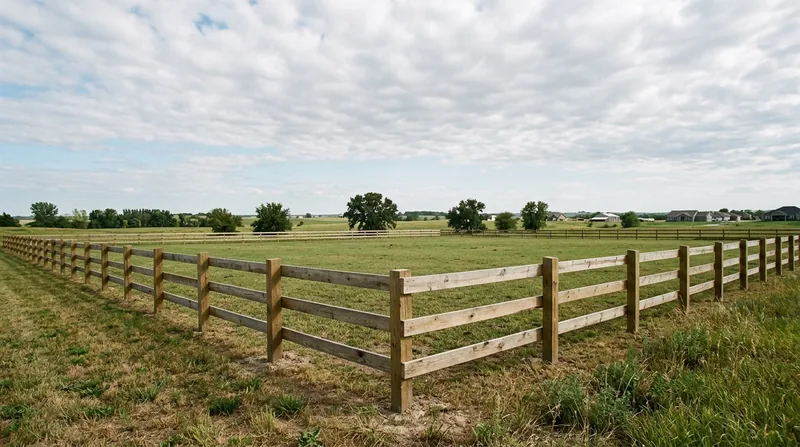




Omaha-area properties with acreage, pastures and working land need farm fence installation in Omaha that stands up to daily use, weather exposure and the demands of livestock and equipment. Whether you are fencing a small horse property in Papillion, a multi-acre ranch near Bellevue, or establishing field boundaries across Greater Omaha, the right fence system saves money over time, keeps animals secure and defines your land clearly. We have installed ranch rail, no-climb horse fence, pipe fencing and field wire systems across Omaha and surrounding counties since 2015, working with property owners who need straight lines over long runs, properly braced corners and gates sized for trailers and working equipment. This page explains how farm and ranch fencing works, what it costs, and how to choose the right system for your acreage.
Why Farm and Ranch Fencing Matters for Omaha Properties
Fencing on acreage serves purposes beyond privacy or property lines. A well-built ranch fence contains livestock, protects pasture investment, and prevents trespassing or animal loss. Omaha's mix of suburban acreage, hobby farms and working ranches means fence systems must handle both the day-to-day wear of animals and equipment, and the seasonal weather exposure that comes with open land. Poor fence design leads to escaped animals, injured livestock, gate failure and costly repairs. The right system, installed correctly with proper post spacing, bracing and gate hardware, pays for itself by preventing loss and reducing maintenance over years.
- Post spacing and concrete depth are sized for the load that the fence will carry, whether that is pressure from animals, wind load on solid panels, or tension in wire systems.
- Corner bracing and anti-sag hardware prevent racking and sagging that turns a straight line into a weak point.
- Gate hardware, hinges and latches must be rated for the weight and frequency of use that working gates receive.
- Material choice, whether split rail, no-climb mesh, galvanized pipe or field wire, depends on the animals you are containing and the look you want.
A fence that is properly engineered from the start holds its line and function for years, and costs less to maintain than a system that was undersized or improperly installed.
Key info: Nebraska 811 utility locates are required by law before you dig any post holes on your property. Call 811 or visit the Nebraska One-Call Center website to request a locate, and wait for the marked utilities before breaking ground. This protects you from hitting buried power, gas, water or communications lines.
How We Install Farm and Ranch Fencing in Omaha
Our approach to ranch fencing starts with understanding your land, the animals you are containing, and the look and durability you expect. We walk the property, identify the fence line you have marked, check for drainage issues and obstacles, and propose a system that fits your budget and use case. We handle all the heavy work: material delivery, post setting in concrete for long-term stability, rail or wire installation with proper tension, and gate hanging with hardware rated for the job. The crew stays on site until the fence is complete, tested and ready to work.
- We request a Nebraska 811 utility locate and wait for the marked utilities before starting any digging.
- We establish the fence line based on your existing survey or the line you have marked on the ground.
- We set posts in concrete at the spacing required for your fence type and load, using a power auger for speed and consistency.
- We install rails, boards or wire, checking for level and tension as we go, and brace corners with angle bracing or diagonal stays.
- We hang and test all gates, adjust hardware for smooth operation, and walk the complete fence with you before we leave.
This step-by-step process ensures that your fence goes up straight, stays in place, and performs the job you bought it for.
Local example: A 4-acre horse property in La Vista with soft ground near the tree line needed a no-climb fence that would not sag in the middle of long runs. We set posts 6 feet apart in concrete, used 2-inch by 6-inch rails with vertical no-climb mesh, and installed diagonal bracing at the corners. The fence went in over 3 days and has held straight for years without sagging or movement.
Farm and Ranch Fencing Methods and Materials
The type of fence you choose depends on what you are containing, how long you want it to last, and your budget. Split rail works well for horses and aesthetic appeal but requires more maintenance. No-climb horse fence is durable and safe for animals. Galvanized pipe fencing is the strongest option for high-traffic areas. Field wire and barbed wire are cost-effective for large acreage but require regular maintenance and proper handling.
| Approach | Description | Best for |
|---|---|---|
| Split Rail | Horizontal rails mortised into posts, typically 3 or 4 rails high, wood or composite material. | Horse properties, aesthetic appeal, smaller acreage, areas where traditional look matters. |
| No-Climb Horse Fence | Pressure-treated or composite rails with welded no-climb mesh, 4 or 5 feet tall, prevents injury and escape. | Horse and livestock containment, high-traffic areas, where safety and durability are priorities. |
| Galvanized Pipe Fencing | Steel or aluminum pipe bolted to posts, extremely strong and low-maintenance, industrial appearance. | Heavy-use areas, large livestock, long-term durability, areas where maintenance access is limited. |
| Field Wire and Barbed Wire | Wire strung tight between posts with tension bands and stretcher bars, cost-effective for large acreage. | Pasture boundaries, large properties, cattle and sheep, situations where cost per linear foot is the driver. |
Each system has trade-offs between upfront cost, maintenance burden and long-term durability. We help you choose the right match for your animals, land and budget.
Farm and Ranch Fencing Cost in Omaha: What to Expect
Farm and ranch fencing cost depends on the material you choose, the length of fence you need, post spacing, terrain and access. Split rail fencing typically starts at around $12 to $18 per linear foot installed. No-climb horse fence runs $15 to $25 per linear foot depending on rail size and mesh height. Galvanized pipe fencing is the most expensive option at $20 to $35 per linear foot, but it lasts decades with minimal maintenance. Field wire and barbed wire are the most affordable at $3 to $8 per linear foot for materials, but labor and proper tensioning add cost.
The factors that move the cost up or down are terrain difficulty, distance from our shop, post spacing requirements, corner bracing complexity and gate count. A property with soft, easy digging will cost less than one with rocky or wet ground that requires extra effort to set posts. A long straight run costs less per foot than a property with many corners, gates and obstacles. We always include a site visit to understand these factors before we quote a price.
The best way to know what your job will cost is to request a free estimate and have us walk the property with you. We will give you a realistic number based on what we see, explain what moves the price, and answer your questions before you decide. Check our pricing page for more detail on how we structure quotes for different fence types and acreage sizes.
Farm and Ranch Fencing Near Me: What Omaha Homeowners Should Know Before Hiring
When you are looking for a fence contractor near Omaha to install or repair ranch fencing, a few things will protect your investment and ensure you get the work you paid for. First, verify that the contractor carries full general liability and workers' compensation insurance. We are fully insured and can provide a certificate of insurance on request. Second, understand that Nebraska does not issue a state license for fence installation, so fence work is not subject to state licensing requirements. However, some municipalities in Greater Omaha may have local requirements, so check with your city or county building department to see if a permit is needed for your project and whether your HOA has rules about fence height, material or color. Third, ask the contractor for references from recent ranch fencing jobs in your area, and call at least two of them to ask about the quality of the work and whether the fence has held up over time.
- Confirm that the contractor is fully insured with general liability and workers' compensation, and ask for proof before work begins.
- Ask whether a permit is required in your city or county, and whether the contractor will handle the permit process or if you need to apply.
- Request at least two references from similar ranch fencing projects completed in the last 2 years, and follow up with those customers.
- Understand your HOA rules if you live in a master-planned community, because deed restrictions often govern fence height, material and color.
- Get a written estimate that clearly states the material type, linear footage, post spacing, gate count and total price, so there are no surprises.
Taking time to verify insurance, understand local rules and check references will save you money and frustration down the road. Contact us to schedule a free site visit and estimate for your ranch fencing project. We serve Omaha, Papillion, La Vista, Bellevue, Gretna, Ralston, Bennington and all of Greater Omaha with the same crew and honest guidance on every job.
Farm & Ranch Fencing in Omaha: Pricing Guide
| Service | Price | Details |
|---|---|---|
| Split Rail Fencing | Starting at $12/ft | Wood or composite rails with mortised posts, 3 to 4 rails high, installed and set in concrete |
| No-Climb Horse Fence | Starting at $15/ft | Pressure-treated or composite rails with welded no-climb mesh, 4 to 5 feet tall, full containment system |
| Galvanized Pipe Fencing | Starting at $20/ft | Steel or aluminum pipe bolted to posts, extreme durability, industrial appearance, minimal maintenance required |
| Field Wire and Barbed Wire | Starting at $3/ft materials | Wire strung with tension bands and stretcher bars between posts, cost-effective for large pasture boundaries |
| Gates and Hardware | From $300 to $1,500 | Sliding gates, swing gates, hinges and latches sized for livestock and equipment, installed and tested |
| Free Estimate | No charge | Site visit, material assessment, post spacing review and written quote within 24 hours of request |
Indicative pricing, the exact cost depends on square footage, finish, and site access. Free personalized estimate within 24h at (531) 541-5896.


